Chicken Soup for the Leadership Soul: What My First Campbell Trophy Summit Taught Me About Who I Want to Be


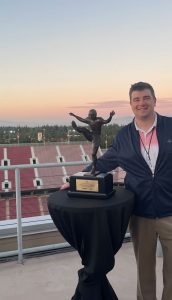
A personal reflection on the 2023 William V. Campbell Trophy Leadership Summit at Stanford University
By David McMahon · davidmcmahon.com · Leadership & Reputation
The Invite That Almost Missed Me
The invitation appeared in my inbox sometime in early 2023, more than fifteen years after I had been nominated to the NFF Hampshire Honor Society as a student-athlete at Butler University. I almost missed it entirely, and not because it went to spam. It just showed up one day, quietly, like something that had been waiting for the right moment.
My first instinct was skepticism. Fifteen-plus years is a long time. When something arrives that connects back to a chapter of your life that feels that distant, and it arrives out of nowhere, the reasonable question is whether it is real. I did what anyone would do: I looked it up, verified the National Football Foundation, confirmed the Summit was legitimate, and registered. Then I waited. The anxiety built slowly. The official notification that I had been selected to attend arrived in May. I read it more than once to make sure I understood what I was looking at.
From May to late July, I prepared the way I prepare for anything I take seriously. I researched past speakers and past attendees. I listened to the Trillion Dollar Coach on a drive from Sarasota to Tampa and then listened again on the way back. I read about Bill Campbell. I scanned the list of confirmed attendees for the 2023 Summit, noting names and organizations I wanted to learn from. I have always believed that how you prepare for something tells you something about how much you actually want it. I wanted this.
What I was not prepared for was the room itself. When I landed in Palo Alto and started meeting other attendees, I discovered I was not the only one who had wondered if the invitation was real. Fellow first-timers admitted they had the same skepticism when the email arrived. How is it year five of this event and I have never heard of it? That question circulated more than once in the first few hours. The answer, it turned out, is simply that the Summit does not promote itself the way most events do. You have to earn your way in, and the people who earn their way in tend to be the kind of people who are not looking for the next thing to put on their LinkedIn profile.
The range of people in the room was remarkable. There were veterans of previous Summits who came back year after year. There were fellow first-timers carrying the same mixture of curiosity and disbelief I was carrying. There were former players from conference rivals I had competed against in college, people from the NFL, people who had served in the military, and a handful of players who had received COVID redshirts and were preparing to head back to graduate school for another year of eligibility in the fall. The generational and experiential span was wider than I expected.
What was immediately striking was what was absent. No one had an agenda. There were no sales pitches, no networking theater, no one positioning themselves for the next deal. What there was, genuinely and from the first conversation, was camaraderie and a shared commitment to personal growth. The unspoken common ground in that room was a desire to be great, not just professionally, but as sons, brothers, husbands, fathers, and leaders in the communities they were part of. That is not a small thing to walk into. And no amount of preparation had told me it would feel that way.
The best description I have found for what those three days gave me is a phrase I keep returning to: chicken soup for the leadership soul. It is not a sophisticated metaphor. But it is exactly right.
When Football Players Talk About Life
The Summit opened with a session featuring three names that would make any serious football fan sit up a little straighter in their chair: Ronnie Lott, Steve Young, and John Lynch. Between them sat more Super Bowl rings, Pro Bowl selections, and Hall of Fame plaques than most people encounter in a lifetime. I am a football fan who played the game at the Division I level. I grew up watching these men compete at the highest level. Sitting twenty feet away from them and hearing them speak was not a small thing.
But here is what I did not expect. Within the first ten minutes, I stopped thinking about their football careers entirely.
Ronnie Lott spoke about why he has your back. Not why he had his teammates’ backs on a football field, but why showing up for the person next to you is the most fundamental act of leadership available to any human being, regardless of whether you are playing for four downs or running a company for four years. Lott described investment in relationships not as a strategy but as a moral orientation. You either show up for people or you do not. The ones who do, he said, are the ones who build something worth having.
Steve Young covered the difference between having a plan and having a dream. He is one of the most accomplished quarterbacks in NFL history and he chose to spend his time talking about purpose, about the courage required to commit fully to something when the outcome is genuinely uncertain, about how the willingness to be uncomfortable in pursuit of something meaningful is what separates the people who build enduring things from the people who merely occupy positions. He talked about BYU and the pressure and the preparation with the same energy he brought to a Super Bowl, which told me everything I needed to know about how he thinks.
John Lynch talked about building championship organizations at the San Francisco 49ers. What he described was not a scheme or a system. It was a culture. The way you recruit. The way you handle adversity. The way you tell people the truth even when the truth is hard to hear. The way you hold yourself to the same standards you hold everyone else. Lynch was candid in a way that felt unusual for someone in his position, and that candor was itself instructive. Leaders who are willing to be honest about difficulty tend to build organizations that can handle difficulty.
These men had spent their careers being the most prepared person in the room. What they were teaching now was that preparation without character is incomplete. Character is the foundation. Everything else is built on top of it.
By the time those three finished, the tone for the entire Summit had been set. This was not going to be a weekend of motivational platitudes delivered by people who had made it and forgotten what the grind felt like. This was going to be honest. Personal. Transferable.
Liz Wiseman and the Language I Did Not Know I Needed
I came to the Liz Wiseman session carrying something I had not fully named yet. There were leadership dynamics at NetReputation at the time that were creating friction I could describe experientially but struggled to articulate objectively. I knew certain interactions were draining energy from the organization. I knew other leaders were generating it. I had instincts about what was happening but not a vocabulary sharp enough to bring those instincts into a room and make them useful.
Liz Wiseman gave me that vocabulary in roughly ninety minutes.
Her Multipliers framework, drawn from her New York Times bestselling book of the same name, makes a distinction that sounds simple but lands with the weight of something you have known for years without being able to say. Multipliers are leaders who amplify the intelligence and capability of the people around them. They operate from the assumption that people are smart and will figure it out. Diminishers drain intelligence and capability from the people around them. They operate from the assumption that people cannot function at their best without constant direction. Both types of leader often have the same goals. The difference is not intention. The difference is impact.
What made the session powerful, and what Wiseman is exceptional at communicating, is the concept of the Accidental Diminisher. This is the leader who genuinely wants to help, who works hard, who cares deeply, but whose habits and communication style inadvertently suppress the people around them. The Rescuer who jumps in before people have a chance to struggle productively. The Idea Fountain who generates so many ideas that no one else’s ideas have room to breathe. The Pace Setter who moves so fast that the team spends its energy keeping up rather than contributing. These are not bad people. They are often the most enthusiastic people in the organization. But enthusiasm without awareness becomes a form of diminishment.
The most important thing I took from Liz Wiseman was not a framework. It was permission to make organizational friction objective rather than personal.
I flew home from Stanford with pages of notes and a clear sense of what I needed to do. Within a week of returning, I presented the Multipliers and Diminishers framework to our CEO. I did not go in to assign blame or litigate grievances. I went in with a tool that made it possible to talk about leadership behaviors and their organizational impact in a way that was grounded, specific, and actionable. That conversation, which I credit directly to Liz Wiseman and to the Campbell Trophy Summit, drove meaningful change during a genuinely turbulent period at our company. I am not being hyperbolic when I say that one ninety-minute session at Stanford had a measurable impact on how we led.
Admiral McRaven and the Weight of Purpose
Four-Star Admiral William H. McRaven is the author of Make Your Bed, the former Chancellor of the University of Texas System, and one of the most decorated military commanders in American history. He oversaw the operation that resulted in the capture of Saddam Hussein and the raid that killed Osama bin Laden. He has stood at the intersection of leadership and consequence in ways that are genuinely difficult to comprehend from the outside.
None of that is why his session stayed with me.
What stayed with me was the simplicity of what he believes about leadership. McRaven did not come to the Summit to impress anyone. He came to transfer something true. His central argument, built from four decades of service in environments where leadership failures have irreversible consequences, is that purpose is the foundation of everything. Not strategy. Not talent. Not even character, though character matters enormously. Purpose. If you know why you are doing something, genuinely know it, not the version you put in a mission statement but the version you return to at three in the morning when things are hard, you can lead through almost anything.
He talked about the value of small actions done with complete commitment. Start by making your bed. It is not about the bed. It is about the discipline of beginning each day with a completed task, a small proof of self-respect that compounds over time into something larger. He talked about the relationships that make hard things possible, the teammates who carry you when you cannot carry yourself, and the obligation you take on when someone carries you to be the person who carries them back. He talked about failure, not as something to avoid but as something to absorb and move through with your identity intact.
McRaven reminded me that the clearest leaders are not the ones with the best plans. They are the ones who know exactly what they stand for when the plan falls apart.
In online reputation management, I work with people on some of the worst days of their professional lives. People whose companies are under attack, whose personal names have been weaponized online, who feel exposed and powerless in ways that shake their confidence in themselves and their judgment. McRaven’s framework for operating under extreme pressure, holding your purpose, taking the next right action, maintaining relationships, and refusing to let the hardest moments define you, is directly applicable to that work. I left his session not with tactics but with a deeper understanding of what it means to lead someone through a crisis rather than simply manage one.
Larry Miller and the Dots That Connected
Of all the sessions at the 2023 Summit, Larry Miller’s was the one I thought about most on the flight home.
Miller is the chairman of Nike’s Jordan Brand, one of the most successful consumer brand operations in the world. He grew the brand from a $200 million basketball shoe company into a $4 billion global powerhouse. He previously served as president of the Portland Trail Blazers. He has been a mentor, a board member, and a philanthropist. By any measure, he is one of the most accomplished Black businesspeople in American history.
He is also a man who, at sixteen years old, was incarcerated for murder. He spent years in prison before earning his degree, building a career from scratch, and spending the next four decades keeping that secret while climbing one of the most visible ladders in American business. His memoir, JUMP: My Secret Journey from the Streets to the Boardroom, which he wrote with his daughter Laila Lacy, is the account of how he carried that weight, what it cost him, and why he eventually chose to put it down.
Miller told his story at the Summit without softening it. He did not perform redemption. He described it, with the specificity and the honesty of someone who has had a great deal of time to understand what actually happened and what it actually means. He talked about prison as the place where he discovered that time could work for him rather than against him, that the choice to educate himself was the first genuinely free decision he ever made. He talked about the terror of success, the years of waiting to be found out, the way secrets of that magnitude can hollow you from the inside even when everything on the outside looks like achievement. And he talked about what happened when he finally told the truth, how the fear he had carried for decades did not destroy him, because the man he had become was stronger than the boy who had made that choice.
No one is ever a finished product. Every person in every room is a work in progress. The question is whether you are doing the work.
For me, the connection was immediate and personal. I work in online reputation management. My clients are often people who made a mistake, or were associated with a mistake, or found themselves on the wrong side of a news cycle, and who are now living with the digital consequences of that moment. I work to help them protect and rebuild their reputation not by erasing what happened but by building something stronger around it. Larry Miller’s story is the most powerful argument I have ever encountered for the idea that a person is more than the worst thing they ever did. That argument is not just philosophical for me. It is the operating premise of the work I do every day.
Hearing him tell it at Stanford, in a room full of former college football players at various stages of their lives and careers, many of them recent graduates facing the specific uncertainty of post-football life, was something I will not forget. The Summit’s mission is to connect recent nominees with people who can mentor them. Larry Miller is an extraordinary mentor because he has lived the full arc of what it means to fall, to rebuild, and to use that experience in service of others.
Mark Flynn, the NFF, and What the Room Itself Did
Mark Flynn, the CEO of MWF Advisors and the organizer of the Summit since its inception, was a linebacker at Saint John’s University in Minnesota and a volunteer flag football coach alongside Bill Campbell himself. He is the person most responsible for the Summit existing in the form it takes, and for the culture of genuine engagement and mentorship that makes it different from every other leadership conference I have attended.
What Flynn and the NFF team, including Matthew Sign and Hillary Jeffries, built is not just a speaker series. It is a community with a generational span. The attendees at the 2023 Summit ranged from recent graduates in their early twenties navigating the transition out of competitive football for the first time, to professionals in their thirties and forties in the middle of careers across business, medicine, law, finance, and public service, to retirees in their fifties and sixties who came back year after year because the room continued to give them something they could not get anywhere else. That range is not incidental. It is the design.
The Summit included a flag football game on Stanford’s fields. A trivia challenge on the Jumbotron at Stanford Stadium. Meals and conversations that continued long after the formal sessions ended. The structure was intentional: remove the barriers that keep people in the professional versions of themselves and create conditions where the real conversations happen. It worked. The best thing I took from Stanford in 2023 was not a session or a speaker. It was two conversations over dinner with people I had never met, who were navigating things I recognized, who were generous with what they had figured out. That is what mentorship actually looks like, and it is what the Summit is designed to produce.
I came home different. Not in a dramatic, overnight-transformation way. In the quieter, more durable way that happens when something you already believed about leadership gets confirmed and extended and given a new language by people who have lived it at a level you respect. I came home knowing what I wanted to bring back to my team, my peers in leadership roles, and to the work of building an organization worth being part of. That knowledge has not left.
For Anyone Who Got the Invite and Let It Sit
If you are a former Campbell Trophy nominee or NFF National Scholar-Athlete, the invitation exists. It goes out every year. If you have not seen it, check every folder in your inbox. Verify it is real. Register. Then wait, and let the anticipation build. It is worth it.
The Summit is free to attend and will work to reimburse first time attendees for their travel expenses. All you have to bring is the willingness to show up and the honesty to admit that there are things you do not yet know about leadership that the person sitting next to you might be able to help you with. In my experience, that willingness is the single most important qualification for the room.
Upon my return to Sarasota I had to leverage some of the lessons immediately due to unforeseen challenges at my company. It was an incredible reset after a few fast paced years at NetRep and a fundamental shift about how I understand what I am trying to build and why it matters.
Chicken soup for the leadership soul. It is exactly that.
David McMahon is a Sarasota-based executive, husband, father and coach. He writes about leadership, reputation, and building teams worth being part of at davidmcmahon.com.
● RESOURCES & LINKS
Watch the Sessions
Liz Wiseman — Multipliers Workshop at the 2023 Summit: https://youtu.be/ZQrrTb3M5JE
Admiral McRaven — Purpose and Leadership (2023 Summit): https://youtu.be/CJNYb0kQ1hU
Larry Miller — Second Chances (2023 Summit): https://youtu.be/z5H7S6pq-o4
Books Referenced
Trillion Dollar Coach (Eric Schmidt, Jonathan Rosenberg, Alan Eagle): https://www.amazon.com/dp/0062839268
Multipliers: How the Best Leaders Make Everyone Smarter (Liz Wiseman): https://www.amazon.com/dp/B08QS3F3NR
Make Your Bed (Admiral William H. McRaven): https://www.amazon.com/dp/1455570249
The Wisdom of the Bullfrog (Admiral William H. McRaven): https://www.amazon.com/dp/1538722070
JUMP: My Secret Journey from the Streets to the Boardroom (Larry Miller): https://www.amazon.com/dp/0062999818
The Campbell Trophy Summit & NFF
Campbell Trophy Summit (official): https://www.campbelltrophysummit.org
National Football Foundation: https://www.footballfoundation.org